



From First Timer to Finisher: Your Guide to Surviving (and Enjoying) Your First Long Distance Trial (LDT)

You can read every guide on the internet, watch countless videos, and spend hours staring at route books, but there is a moment, usually about twenty minutes after setting off on your first Long Distance Trial, when it suddenly clicks.

This is not just a bike ride. It is a full day of tiny decisions: kit, fuel, navigation, timing, and etiquette. Stack enough of those decisions together across green roads, lanes, byways, private land, and observed sections, and you begin to understand why Long Distance Trials are one of the most rewarding days you can have on two wheels.
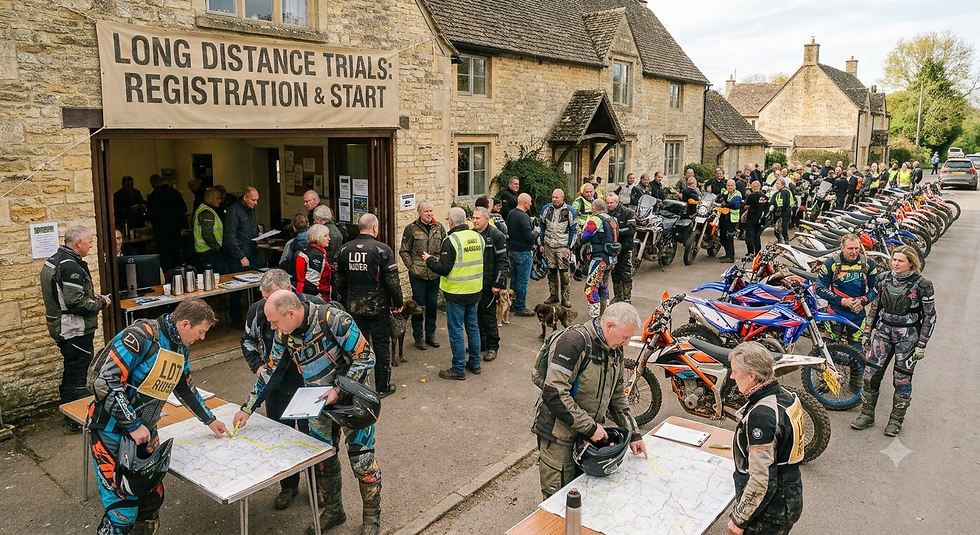
For most club LDTs, you are looking at a proper day out: often 60 to 100-plus miles, with observed sections tucked into the route to keep you honest. The Motor Cycling Club (MCC) events are a different creature again. They are longer, run through the night, and can stretch into the sort of mileage where your headtorch, fuel range, and sense of humour all become equally important.
If you are getting ready for your first LDT, this guide is not here to make the day perfect. Perfect is overrated. The aim is simpler: turn up prepared, stay legal, respect the event, and enjoy the ride enough that you start looking for the next one before the mud has even dried on your boots.
A Note on Motor Cycling Club (MCC) LDTs
The Motor Cycling Club (MCC) events deserve a mention because they sit slightly apart from the average Sunday club LDT (which are often more technically challenging); however, they are all rewarding in their own unique ways. The MCC has been organising classic long-distance trials since 1901, and events such as the Exeter Trial, Land's End Trial, and Edinburgh Trial have a character all of their own.
These are not short blasts around a local route with a handful of sections tucked in for good measure. MCC trials are big, historic, overnight long-distance events that involve motorcycles, cars, three-wheelers, and sidecars, all sharing the same basic adventure within their own class structure and route. That gives them a wonderfully mixed feel: one minute you are queuing behind another motorcycle, the next you are watching a determined vintage car crew attack the same hill with more optimism than horsepower.
The route book becomes your travelling companion. It is not just guidance; it is part of the event. You will be working through mileages, direction posts, passage controls, observed sections, quiet zones, time controls, fuel halts, a few special tests, and a good sprinkling of restarts to add further interest to that slippery hill. It can feel a little daunting at first, especially when you are trying to read instructions in the dark while your gloves have developed the dexterity of oven mitts, but once you settle into the rhythm, it becomes part of the charm.
The big difference with MCC events is scale. You need to think beyond "Can I ride the sections?" and start thinking "Can I manage the whole event?" That means preparation, lighting, layers, fuel planning, timekeeping, stamina, navigation, and keeping yourself fed and alert when most normal people are asleep.
It is adventure by route card, and that is exactly why it gets under your skin.

1. Choose Your Trusty Steed
Before you even think about the first observed section, you need the right bike for the job. A modern competition trials bike might look tempting. It is light, nimble, and brilliant in a traditional trial. Unfortunately, it is less brilliant when you are still three villages away from the next fuel stop, your tiny tank is making nervous noises, and your backside has officially submitted a written complaint.
For an all-day LDT, a lightweight trail bike is usually the more sensible choice. The exact bike matters less than whether it is genuinely suitable for the day. A good LDT machine needs a reasonable fuel range, a tolerable seat, proper road equipment, compliant tyres, and enough comfort to keep you making sensible decisions long after breakfast has become a distant memory.
Great options include: Beta Alp, Beta XTrainer, Sherco X-Ride, Yamaha Serow, GasGas Pampera, KTM Freeride and so on.
A well-sorted 250cc trail bike is about as close to LDT perfection as you will find. Forget the idea that bigger is automatically better. In slippery lanes, tight sections, and long days in the saddle, manageable beats macho almost every time.
TIP: Check Your Wheel Sizes & Hybrid Specs
The 21′′/18′′ Wheel Rule: Make sure your bike runs a 21-inch front and an 18- inch rear wheel. If your bike has a 17-inch or 19-inch rear wheel, you will struggle to find street-legal, approved trials tyres.
A Note on Hybrid Bikes: Bikes like the Montesa 4Ride, TRS X-Track, or GasGas Randonne are fantastic fun, but be aware they are not eligible for ACU Trail Bike Championship points if thats your aim. Their shorter wheelbase (under 1350mm) and smaller fuel capacity (under 5L) exclude them from championship scoring. As Kev Miller (see acknowledgments) wittily puts it: "Fitting trials tyres to an enduro bike does not make it a trail bike!"
Do Not Forget the Legal Bits
The scrutineer is not the person you want to surprise on event morning. Make sure you have: A valid motorcycle licence, MOT (where required), Road tax, Continuous insurance, A road-legal machine, working lights, horn, and speedometer (where required), Trials-suitable tyres, such as Michelin X11 or Pirelli MT43.
Always check the specific event regulations before making a tyre choice. Some clubs do not allow certain tyres, and discovering that while standing in the signing-on queue is not character-building; it is just annoying. For example, not all events allow the use of the Maxxis Trialmaxx.

What Scrutineers Check Before the Start
Beyond basic road legality, scrutineers will walk around your bike at sign-on. To avoid a non-start, ensure you have checked the following:
Ball-ended levers: Both clutch and front brake levers must have rounded ball ends.
Self-closing throttle: Your throttle must snap back closed smoothly on its own.
Engine cut-out switch / lanyard (if fitted): Must be fully operational.
Folding footpegs: Rigid pegs are a safety hazard and will fail inspection.
Helmet standard: Your helmet (full or open-face) must meet road homologation standards (ECE 22.05 or ECE 22.06).
ACU Licence: You will need a full ACU trials licence (£35 per year from 2026).

2. The Night-Before Routine
The secret to a calm event morning is not motivation. It is preparation. The best riders are not organised because they were born with clipboards in their hands. They are organised because, at some point, they forgot something important. Usually once, sometimes twice.
Read the final instructions, then read them again.
Check your start time, venue, signing-on arrangements, and fuel stops.
Print your route book if one is issued.
Fit or check your route holder.
Lay your kit out in three piles: wear, carry, and bike.
Charge your phone (GPS and lights if required).
Download What3Words (handy for recovery).
Fuel the bike.
If you ride a two-stroke, pack your oil and measuring bottle.
Set your alarm earlier than feels necessary.
Eat something sensible.
Drink water.
Pack a few more snacks than pride says you need (although there are usually a good few cake stops on MCC events).
That last point is important. Pride has very poor judgement at mile marker 100. If you are riding an MCC event, take the night element seriously. Lights, layers, fatigue, and navigation all matter more once the rest of the world has gone to bed and you are trying to work out whether that faint shape ahead is a direction marker, a hedge, or another rider having a quiet moment of reflection.
For all events, do not treat the route book as something you will simply "work out on the day or night in the case of MCC events". Read it in advance. Mark the key controls, fuel stops, food stops, quiet zones, observed sections, restarts, and any instructions that apply specifically to your class. Make sure you understand the event's standard time and scheduled time system before you are stood at the start control pretending that mental arithmetic is easier while wearing a helmet.
It is also worth preparing for the odd little realities of overnight trialling. You may be leaving a start venue late in the evening, riding through quiet villages, stopping for fuel when the rest of the world is asleep, and arriving at sections in the early hours when mist, cold hands, and tired eyes all join the party. Good lights are essential, but so is the ability to keep calm, read the instruction, and not follow the rider in front purely because they look confident. Confidently wrong is still wrong.

3. What to Bring, and What to Leave in the Garage
Your mission is surprisingly simple: stay warm enough, stay dry enough, stay fed enough, and stay calm enough. Do that consistently for six to eight hours and you are already doing well. On MCC events, where the hours and miles stretch further, that balance becomes even more important.
Must-Haves
Bring water and food you will actually eat. A mix of salty and sugary snacks works well, because at some point you will want both. Your bike should comfortably manage the fuel range required by the event, ideally with a margin for small navigational misunderstandings (otherwise known as "exploring").
Bring some gaffer tape for sticking the numbers on your bike and the rear of your helmet (or the rear of your bike on MCC LDTs).
Carry basic tools that fit your bike. A puncture plan is also worth thinking through and practicing before you are stood beside a flat tyre wondering if optimism counts as equipment. Layers matter, and a paper backup is worth carrying: key phone numbers, the venue address, emergency details, and anything else you might need if your phone chooses the worst possible moment to become a small black rectangle of disappointment.
Nice-to-Haves
Microfibre cloth, Cable ties, Earplugs (more so on MCC events), Buff, Small first-aid kit.
What I Would Leave Behind
Helmet cameras and body cameras, as ACU motorcycle events do not allow them.
Loud exhausts, unless you enjoy awkward conversations and not starting the event.
Mountains of "just in case" equipment that require unpacking half the bike every time you need something.
Brand-new, untested kit.
PACKING HACK: The 21-Inch Tube Trick - Don't haul two heavy inner tubes for 80 miles. Carry a single 21-inch front tube in your pack. In a pinch, a 21-inch tube can be fitted inside an 18-inch rear tyre to get you out of trouble and back to the finish line.
Smart Gear Additions
Trials Boots > MX Boots: Opt for trials boots, over rigid motocross boots which also offer zero grip when you are walking down slippery, wet, muddy banks, although I do prefer the ankle support and protection of my Alpinestars Tech 7 enduro boots and get on fine with them (even if I am no LDT star).
Bifocal Safety Glasses: A pair of clear safety glasses. If you struggle to read small print on a route card, grab a pair of bifocal safety glasses so you can read your route book without swapping specs mid-lane!
Note on Navigation: I found I got on better when I made the leap to a digital roadbook reader as hated using bifocal glasses. Although some LDT purists seem to frown on this tech and consider it cheating, I see it as using a digital format of the exact same thing they are using. Saying that, I can understand their point when using a GPX track; however, if it brings more people in to to the sport so be it. Anyway, variety is the spice of life and all that!
I am now using DMD2 on a Samsung Active Tab 3 (soon to be complemented with a Hugerock X72) - More to come on that in future posts such as 'From Plastic Wallets, Bacon Butty Boxes, to Dakar Digital Roadbooks' and more.

4. Etiquette: How to Be the Rider Everyone Likes
Long Distance Trials only exist because volunteers, landowners, clubs, and observers put in a huge amount of work behind the scenes. A little courtesy goes a very long way. Thank the observers and marshals, queue properly, help others without crowding them, and be considerate around horses and livestock. If you meet riders coming the other way, slow down, give space, and keep everything calm.
Close every gate, ride quietly through sensitive areas, and leave no trace. Farmers, residents, and landowners remember how riders behave, and the future of events can depend on those small acts of respect repeated all day. The countryside is not your spare parts bin, and goodwill is far easier to keep than rebuild.
CRITICAL ETIQUETTE: Horses & Route Book Privacy
Engine-Off for Horses: Don't just slow down - stop and completely kill the engine when approaching horses, and do not restart until they are well past. This single habit is for the horse and riders safety along with yours, protects landowner and rider relations. Maintaining a good relationship with horse riders, landowners and the general public is vital to keeping LDT routes open.
Keep Route Books Private: Organisers negotiate single-day permissions across private land specifically for the event. Never upload, publish, or share route books online after the event, and especially GPX's.

5. Rules, Scoring, and the Flow of the Day
Most LDTs require pre-entry due to insurance and ease of administration. Observed sections are usually scored in standard trials style, these are explained in more depth at the end of this article, along with details on other organisations that run LDTs. Always check the event instructions before assuming the scoring is the same as the last trial you rode.
MCC events place a much bigger emphasis on following the authorised route and managing controls properly, although it should always be adered to on all events, no cheating now. This helps the organsisers of LDTs to contuine running the events, and from an MCC perspective, it also goes someway to helping continue to run events through the night by managing noise in quiet villages and sensitive areas. The route is not optional, and secret checks may be used to confirm that competitors have followed it. You are responsible for your own navigation, even if every rider around you suddenly appears to have formed a very convincing, but completely lost convoy.
Time controls can matter too. You normally work from standard time, with your own scheduled time calculated from your competitor number. That means you are not simply trying to get round as quickly as possible. You are trying to stay within the event's timing requirements, reach controls correctly, and avoid penalties for arriving or departing outside the permitted window.
Restarts and special tests can also feature on LDTs, more so on MCC events. On a restart, the challenge is not just getting up the hill; it is stopping in the correct box or line on some events, waiting for the marshal's signal, and moving off cleanly at the first attempt within the allowed time, without putting a foot down (footed or a dab). It sounds straightforward while reading the regulations at the kitchen table. It feels slightly more interesting when the hill is greasy, after 8 hours or more of riding, and several people are watching.
6. Navigation and Mindset: The Secret Items
An LDT is not a race. The winner is not the person who arrives first. It is usually the rider who gains the fewest marks in the observed sections while managing the route, timing, and rules properly. Choose your navigation method before the start and trust it. If you are unsure of a turn, slow down early. A ten-second pause is much cheaper than a ten-mile detour.
On all LDT events, navigation is part of the sport. Learn the abbreviations before you start:
R: Right
L: Left
SO: Straight on
Rbt: Roundabout
T-junc: T-junction
dp: Direction post
Q / QQ: Quiet and care zones
Most non-MCC LDTs also use red flags, which you keep on your right, and blue flags, which you keep on your left. These markings are not decorative. They are the language of the sections.
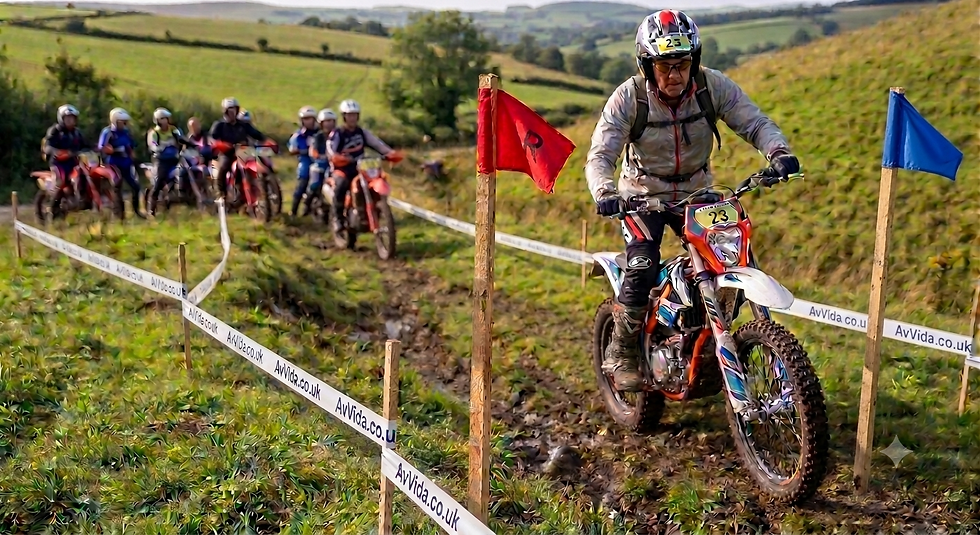
Quiet and care zones deserve particular respect. They are often in sensitive areas where the future use of the route depends on competitors behaving properly. Slow down, keep the noise down, use dipped lights where required, do not stop unnecessarily, and remember that one noisy rider can undo a great deal of goodwill built up by many careful ones.
A good rule of thumb is simple: ride your own event. Do not blindly follow a group just because they look like they know where they are going. They may be riding a different class, following a different route, or heading towards a different section. They can also be wrong just as efficiently as anyone else, only with more witnesses.
Treat mistakes as information, not drama. Missed a turn? Learn from it. Dropped a dab? Learn from it. Took the scenic route through a hedge? Definitely learn from that. The riders enjoying themselves at the finish are usually the ones who let mistakes go quickest.
7. Pace Yourself
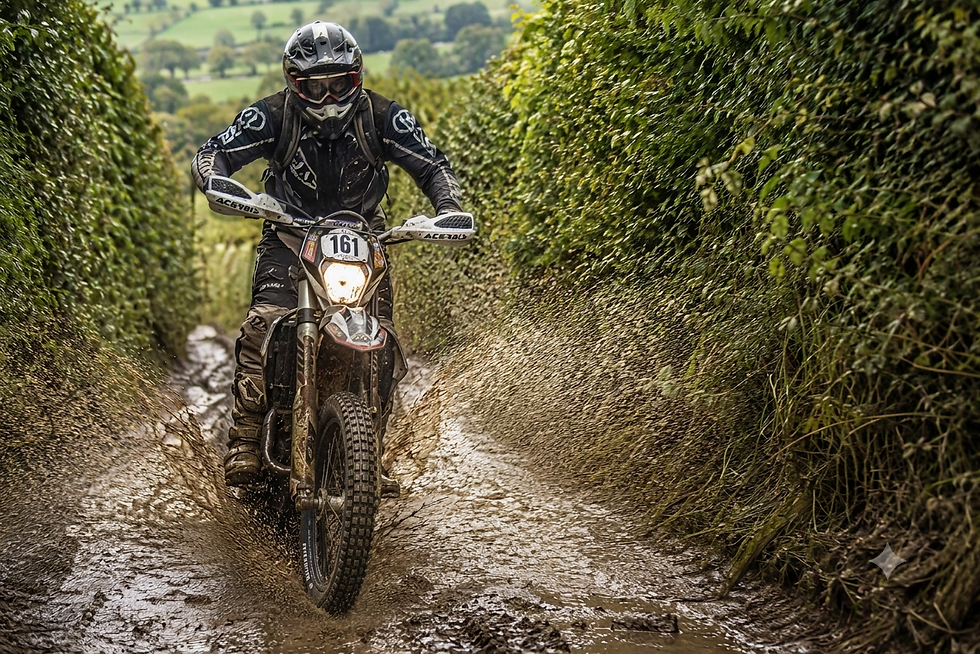
Aim for steady. Not heroic. Not flat out. Just steady. Your first LDT is not about proving anything. It is about discovering what works for you: what kit you actually use, how you navigate best, how your bike behaves, and how you cope when tired, wet, hungry, or slightly lost.
Somewhere between the muddy lanes, the observed sections, the laughter at fuel stops, and the stories at the finish, it starts to make sense. The appeal is not just the riding; it is the whole day: the preparation, the community, the small challenges, the daft moments, and the satisfaction of getting yourself and the bike to the end. Better still, every LDT quietly sharpens your bike skills, one slippery climb, awkward turn, and muddy restart at a time.
And fair warning: once the LDT bug bites, there is usually no cure.
TWO GOLDEN RULES FOR FINISHING
1. Leave the Pressure Washer at Home: Portable power washers are strictly banned at start/finish areas under ACU Regulation TSR41 to protect the environment and landowners' property.
2. Always Sign Off: Whether you finish all 80 miles or drop out at mile 10 with a mechanical issue, you must sign off at the start/finish desk. If you don't sign off, organisers will assume you are lying broken in a ditch and will send out search parties or emergency services looking for you.
Over to You
What is your next event? Drop the event name, your bike, and the one thing you are most nervous about in the comments below. Chances are, we have all worried about exactly the same thing at some point.

Appendix: Decoding LDT Scoring
LDT Scoring for the Auto Cycle Union (ACU), Amateur Motorcycle Association (AMCA), Association of Classic Trails Clubs (ACTC) and the Motor Cycle Club (MCC).
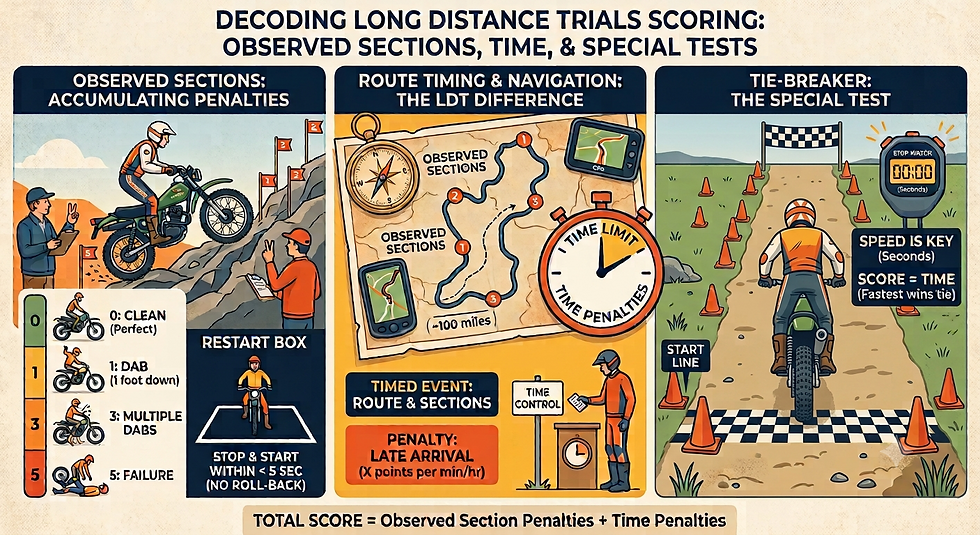
Sections are scored using traditional cumulative penalty points (0, 1, 2, 3, 5). ACU and AMCA long-distance events penalise the exact number of times you foot or lose momentum, meaning the rider with the lowest total score wins.
ACU long-distance events are strictly run under TSR 22B (Non-Stop Rules).
Penalty Points Breakdown
0 Marks (Clean): Successfully navigating the entire observed section without putting a foot down and maintaining continuous forward motion.
1 Mark: Footing or "dabbing" exactly once for balance.
2 Marks: Footing or dabbing exactly twice.
3 Marks: Footing three or more times, as long as the machine keeps moving forward.
5 Marks (Failure): Awarded for a complete failure to clear the section.
Conditions for a 5-Mark Failure
Under the non-stop rule, you instantly receive 5 marks if:
The bike stops moving: The motorcycle ceases to maintain forward motion (stalling, stopping, or hopping sideways without moving forward).
Dismounting: The rider steps off or puts both feet on the same side of the bike.
Boundary errors: Any wheel crosses a boundary tape or goes on the wrong side of a
marker flag.
Displacing markers: Knocking over or displacing a marker flag defining your route.
Rolling backward: Traveling in a direction opposite to the section's path or crossing your own track.
Failing to attempt the section: (If you inform the observer you are not attempting it).
Note: Sometimes 10 points are awarded if you fail to tell the observer you are not going to attempt the section, or simply miss it entirely due to being navigationally challenged on that part of the route book.
Main Differences from MCC Trials
No Medals, Just Placements: You are not competing for a Gold/Silver/Bronze standard against the club; you are competing head-to-head against other riders for overall placement (1st, 2nd, 3rd).
Dabbing Is Allowed: On designated hill climb sections, you can paddle your feet to fight your way to the top. As long as the bike never stops moving forward, you will only drop 3 marks instead of failing completely.
The Motor Cycling Club (MCC) Observed Section Scoring
MCC trials do not use cumulative penalty points to determine a winner. Instead, you are competing directly against the sections/hills and the club's standard to earn specific medals based on how many clean runs you achieve:
The Binary Standard: You either clear an observed section (Clean) or you Fail. There is no partial credit for getting halfway up a hill.
Gold Medal: Awarded to competitors who successfully clean every single observed section on the route, complete all special tests correctly, and strictly adhere to the official time schedule.
Silver Medal: Awarded if you fail exactly one observed section during the trial.
Bronze Medal: Awarded if you fail exactly two observed sections.
Finisher's Certificate: Awarded if you complete the route and attempt at least 75% of the
hills but incur three or more failures.
Motorcycle Footing Rules: For bikes, footing is usually only permitted within the first 3 metres of a section; any subsequent touch or stop constitutes a failure.
Where Special Tests Actually Fit In
Because the scoring is purely based on medal tiers, Observed Special Tests (timed sections) are solely used as a tie-breaker. They do not add points to your score, but if multiple competitors in a specific vehicle class get a Gold (or are tied for a Class Award), the individual with the fastest aggregate time on the special tests wins the Class Award.
The Association of Classic Trails Clubs (ACTC) Observed Section Scoring
Clean (0 Marks): Reaching the top of the section without any penalties, stoppages, or
unauthorised footing means you get zero points.
Sub-divided Markers: Sections feature numbered gates or markers (frequently counted down from 12 to 0, or rising depending on the club's specific format).
Failure Penalty (Max Marks): Stopping, failing to clear a gate, rolling backwards, or putting a foot down (footing) outside the permitted area results in scoring the maximum penalty for that section (typically 12 points).
Motorcycle Footing Rules: For bikes, footing is usually only permitted within the first 3 metres of a section; any subsequent touch or stop constitutes a failure at that exact spot.
🏍️ The LDTs My Wife And I Have Tackled
None of these brilliant events would even exist without the tireless dedication of local motor clubs and volunteer marshals.
Here is a breakdown of the LDTs we've had the absolute privilege (and occasional mud-splattered agony) of taking part in, along with a massive nod to the clubs that make them happen:
🌲 South West & Devon Gems
1. Steve Knight Tarka Trial & Exmoor Trial LDT
Organised by: North Devon Motor Club (NDMC)
The Lowdown: Proper North Devon terrain, sweeping moorland views, slick rocky tracks, and steep gradients demanding smooth momentum and clever line choices.
Club Shout-out: Massive thanks to North Devon Motor Club for running two standout events on the South West calendar. The sheer variety of lanes and terrain they secure year after year is top-tier, complete with top-notch route planning and welcoming marshals on every section.
2. Woohoo LDT
Organised by: South Devon Motor Club (South Devon MCC) (private Facebook group)
The Lowdown: A cracking, high-energy local event blending technical green roads/lanes, steep climbs, and classic Devon lanes.
Club Shout-out: Big thanks to South Devon MCC for putting on an absolute belter of an event, complete with top-notch route planning.
3. Jubilee LDT
Organised by: Somerset Trail Riders Fellowship (Somerset TRF)
The Lowdown: A proper rider’s trial weaving through classic Somerset trail country, balancing technical lane work with flowing liaison sections.
Club Shout-out: Huge props to Somerset TRF. Beyond running a fantastic trial, their ongoing work protecting trail access and maintaining rights of way across the region is invaluable to the whole biking community.
🏴 Welsh Wilderness
Fred Rist LDT
Organised by: Neath Motor Club (NMC)
The Lowdown: A proper staple on the Welsh calendar. Expect sweeping valley views, technical rocky climbs, and rugged mountain terrain that tests your bike's setup and your own endurance to the limit.
Club Shout-out: Diolch! A huge shout-out to Neath Motor Club for organising one of the most scenic, rewarding, and challenging single-day trials in the country.
🏆 The MCC Classics ("The Big Three")
Events: The Exeter Trial, The Land's End Trial, and The Edinburgh Trial
Organised by: The Motor Cycling Club (The MCC)
The Lowdown: Over a century of heritage packed into three legendary endurance tests. Featuring classic overnight road sections, historic observed hills, and gruelling distances, these remain a grand standard for long-distance motorcycle trialling in the UK.
Club Shout-out: A huge tip of the helmet to The Motor Cycling Club (MCC) for keeping this century-old tradition thriving. Riding through the dead of night to tackle legendary hills at dawn is something every trail rider ought to experience at least once.
Acknowledgments: This article was made possible in parts thanks to extensive information produced by Kev Miller. His expert insights were shared with permission from the private Long Distance Road Trials, LDT's, Lightweight Bikes UK facebook community (which means readers will need to request to join to view the original information used) along with an up to date of all the LDTs that are going on.


Comments